
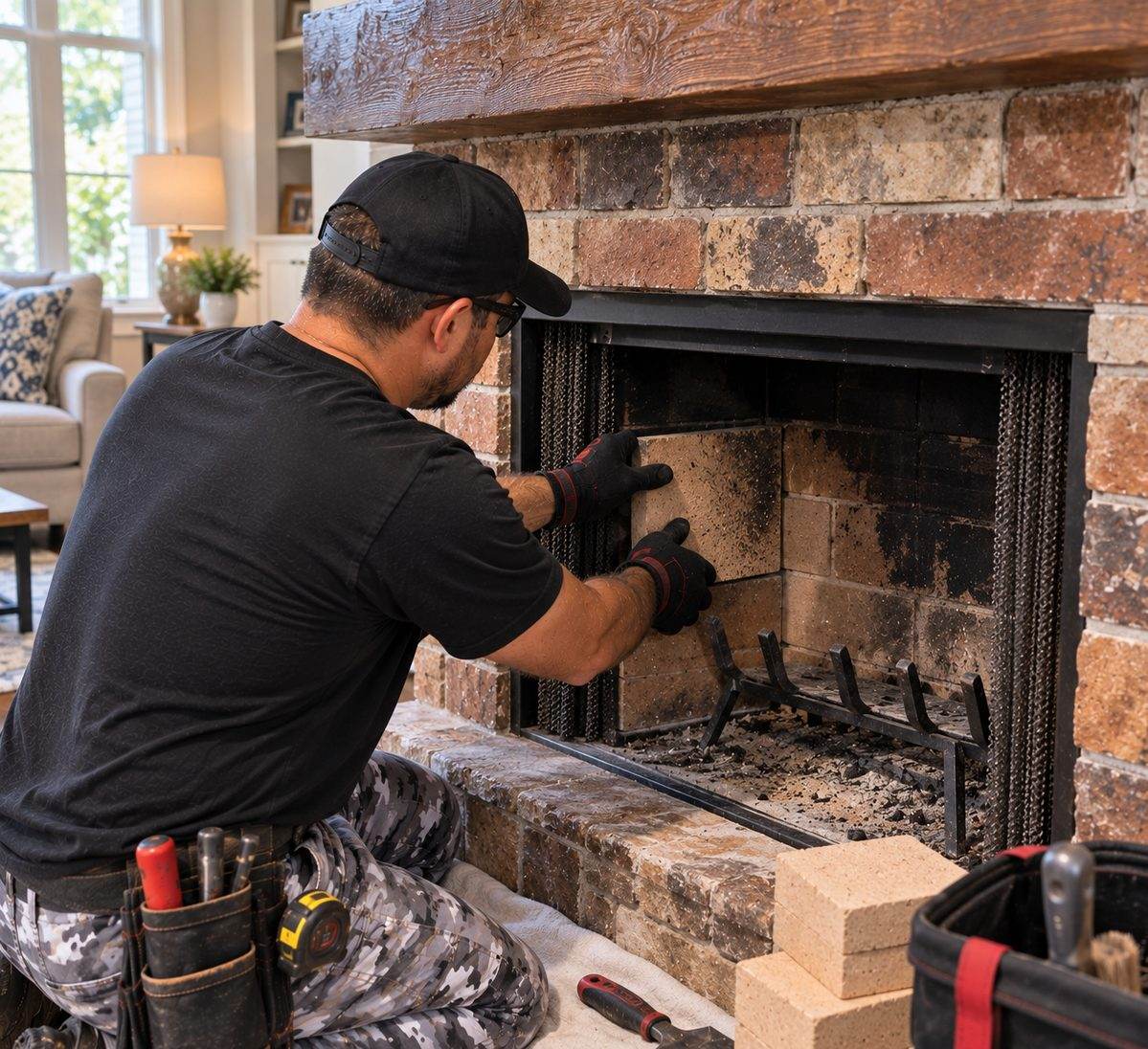
The brick pattern inside many factory-built fireplaces is not individual firebrick. It is molded into refractory panels that line a metal firebox. These panels help protect the appliance structure and reflect heat as part of a tested system. Fine surface checking, an open crack, a missing corner, a bowed panel, and exposed metal are not equivalent conditions, and the correct response depends heavily on the fireplace manufacturer and model.
A generic tube of refractory cement is not automatically an approved repair. Before any fireplace refractory panel repair, identify the unit, locate its manual and service-parts information, document the defect, and evaluate water or metal damage around it. Factory-built fireplaces rely on specified parts, clearances, and assembly—not field masonry improvisation.
On this page
- Identify the unit before judging the panel
- Understand what the panels are doing
- Describe the defect precisely
- Hairline guidance is model-specific
- Repair compounds have limited, approved uses
- Replacement panels must fit the identified system
- Rust and water staining point beyond the panel
- Evaluate the complete factory-built fireplace
- Do not disturb logs, media, or gas components
- Heat damage can involve more than the panel
- Repair work needs room protection and final verification
- Frequently asked questions
Identify the unit before judging the panel
Look for a rating plate or label only in locations safely accessible under the owner’s manual, often near the opening, behind a screen, or around a control area. Record the complete manufacturer, model, serial number, fuel type, and any listed accessory information. Do not remove trim, panels, louvers, or gas components to search.
Model names can be similar while panel dimensions and part numbers differ. The year or serial range may also affect the correct replacement. A photograph of the entire fireplace, label, panel pattern, doors or screen, and chimney chase can help the service provider research the unit before arrival.
Majestic’s official support page instructs owners to use the exact model to locate installation, owner, and service-parts manuals. That approach applies broadly to manufactured hearth products even when the installed brand is different. Majestic user guides and manuals.
Understand what the panels are doing
Refractory panels are designed to withstand fireplace heat and protect or insulate the metal firebox within the tested assembly. They may form the rear, sides, floor, or top depending on model. Seams between panels can be intentional and should not be mistaken automatically for cracks.
The panel also influences how heat is reflected into the room and toward other appliance surfaces. Thickness, backing, retainers, edge clearances, and pattern can be part of the design. Adding a layer over the face or inserting ordinary masonry can change those relationships.
Because the metal firebox can move as it heats, some surface lines may develop without immediate loss of function. Only the applicable manufacturer guidance and condition assessment can determine what is acceptable for that unit.
Describe the defect precisely
Photograph the entire panel and a close view after the appliance is completely cold. Note whether the line is hairline or open, limited to the surface or apparently through the panel, stable or growing, and whether edges align. Look for missing pieces, loose sections, crumbling, bowing, or a crack reaching the panel edge.
Do not insert a knife, screwdriver, or gauge into the crack. Probing can enlarge a brittle defect or damage backing material. A ruler held near the surface for a photograph is safer if it does not require reaching into an unstable area.
Check panel seams and retainers visually without moving them. A displaced panel can expose metal even if the panel itself is uncracked. Black soot lines, rust streaks, or pale water marks add useful context but do not independently determine serviceability.
Hairline guidance is model-specific
Some manufacturers provide limits or examples for small surface cracks that can remain in service; others direct replacement under defined conditions. The threshold may depend on whether metal is visible, material is loose, the crack passes through, or the panel remains secure.
Do not transfer a measurement from an online manual for another model. Even within one brand, products can use different panel construction and instructions. The service provider should cite the correct document or technical guidance when recommending observation, repair, or replacement.
If the model cannot be identified, state that uncertainty. An unavailable part or unknown listing can change the practical options, but it does not authorize a universal patch.
Repair compounds have limited, approved uses
Where the manufacturer permits a crack repair, it may specify a refractory cement, preparation method, maximum defect, application thickness, and cure or firing procedure. The panel must remain stable and sufficiently intact to support the repair.
Smearing material across a loose or bowed panel does not restore its fit. Filling large missing areas can alter thickness and expose the metal assembly to different heat. Ordinary mortar, tile grout, concrete patch, drywall compound, or household caulk should never be substituted.
Ask for the product data and written method. After repair, retain the record with the fireplace manual so later technicians know that the line was treated rather than assuming the panel is original.
Replacement panels must fit the identified system
The preferred replacement may be the original manufacturer part for the exact model and position. When an approved original is unavailable, some systems or qualified repair approaches may permit a listed or specified replacement material cut and installed according to documented requirements. That decision needs more than matching the brick pattern.
Panel thickness, dimensions, edge gaps, backing, retainers, orientation, and sequence matter. A panel forced into place can bow or crack. One cut too small can expose metal or create a gap that the design does not permit. Painting a mismatched panel to look original may introduce an unapproved coating.
The estimate should identify whether one panel or a complete set is being replaced, the source or specification, and how fit will be confirmed. Removing adjacent panels can reveal corrosion or insulation damage that deserves documentation before closure.
Rust and water staining point beyond the panel
Orange streaks, rusted floor metal, white deposits, swollen material, or damp odor suggest moisture exposure. Water may enter at the termination, chase cover, storm collar, siding, roof flashing, or another exterior detail. Replacing the panel without stopping active entry can damage the new part and concealed metal.
A framed chimney chase often has a broad metal top and a factory-built chimney termination. A corroded chimney chase cover or failed collar can be part of the leak path. Water can travel, so the stain location does not prove the exact entry point.
Rust on the firebox or chimney components may affect the listed system. Do not sand and repaint it before the extent is evaluated. Cosmetic coating can hide perforation or loss of material.
Evaluate the complete factory-built fireplace
A broader prefabricated fireplace repair inspection can include accessible firebox metal, panels, grate, screens or doors, air spaces, chimney connections, chase, termination, and labels. Each observation should be tied to the identified model and access limits.
The fireplace may have been altered by aftermarket doors, a gas-log set, an insert, added masonry facing, or a replaced chimney cap. Accessories that physically fit are not automatically approved. Provide manuals and receipts from earlier work if available.
When a listed component is obsolete or the metal firebox has severe damage, replacement of the complete unit may be considered. That conclusion should be supported by condition and parts availability, not age alone.
Do not disturb logs, media, or gas components
Some factory-built fireplaces contain a gas log set or are factory gas appliances. Logs and media can require exact placement for flame and combustion. Do not remove them simply to photograph a rear panel unless the manual tells the user how and the system is safely shut down.
If gas odor is present, leave without operating switches, flames, or controls and contact emergency services and the gas utility from a safe location. If a carbon-monoxide alarm sounds or anyone feels ill, leave and call emergency services.
A panel appointment involving gas components may require a qualified gas technician as well as fireplace expertise. The scope should identify who reconnects and tests the appliance.
Heat damage can involve more than the panel
Discoloration, warped metal, melted trim, damaged screens, or a fire outside the intended area can indicate overfiring, improper fuel, altered clearances, or another event. Stop using the fireplace and preserve evidence. A new panel alone should not be used to conceal the incident.
Burn only fuel permitted by the unit. Do not load logs against panels, use liquid accelerants, or install a grate other than one permitted for the model. Factory-built open wood fireplaces usually have limits different from masonry fireplaces or stoves.
After any suspected damaging event, the chimney and termination may need an appropriate inspection. The visible panel is only the room-side component.
Repair work needs room protection and final verification
Panel removal can release fragile pieces, soot, and refractory dust. Protect the hearth and flooring and keep occupants and pets away. Cutting replacement refractory requires suitable dust controls and respiratory protection.
The installer should verify retainers, seams, clearances, and panel stability before returning logs, grate, doors, or screens. For gas equipment, perform manufacturer-required leak, ignition, flame, and safety checks. For wood units, observe cure and first-fire instructions for any repair material.
Final photographs should show the full panel set and label the replaced position. Keep the part number, invoice, manual, and any limitation in the property record.