
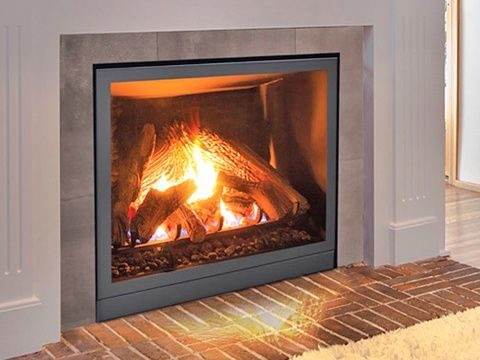
Gas logs are sold in realistic styles, but appearance is one of the last decisions—not the first. The existing fireplace must be identified, inspected, and measured. Fuel, venting category, burner dimensions, input, clearances, damper requirements, controls, gas-line route, and the owner’s goal all affect compatibility. The largest log set that fits between the side walls may still be wrong for the opening or vent.
Professional gas log set installation begins by answering two questions: What fireplace is this, and what should the finished system do? A decorative vented set and a listed heating insert produce different performance and require different planning.
On this page
- Identify the host fireplace
- Decide whether the goal is appearance or heat
- Vented and vent-free are different categories
- Measure more than front width
- Natural gas and propane are not interchangeable
- The chimney and damper remain part of a vented set
- Select ignition and controls intentionally
- Log placement is a combustion requirement
- Factory-built fireplaces demand model approval
- Plan for inspection and maintenance
- Account for moisture and indoor-air effects
- Compare a log set with a gas insert
- Frequently asked questions
Identify the host fireplace
A site-built masonry fireplace is not the same as a factory-built metal fireplace with refractory panels. Some manufactured fireplaces allow specified gas-log accessories; others prohibit them or limit models and inputs. Brick-pattern panels do not prove masonry construction.
Look for a factory rating plate only where safely visible. Record manufacturer, model, serial number, and fuel information. Do not remove panels or trim. For masonry, document the firebox, hearth, damper, smoke chamber, and flue condition through an appropriate fireplace inspection.
If the host cannot be identified or the factory manual is unavailable, do not assume a “universal” log set is acceptable. Physical fit does not establish listed compatibility.
Decide whether the goal is appearance or heat
Many vented gas-log sets are designed primarily for flame appearance in a suitable fireplace and may send substantial heat up the open flue. A gas insert is a different appliance category, commonly using a sealed or controlled combustion system and dedicated venting to deliver more usable room heat.
Before shopping, rank priorities: realistic open flame, remote convenience, supplemental heat, operation during certain outages, low maintenance, glass-front appearance, or preserving the open fireplace. No one product maximizes every goal.
Ask for published performance information under the intended installation, not a claim that all gas products “heat the same.” Room size, home layout, insulation, climate, and operating pattern influence comfort.
Vented and vent-free are different categories
A vented gas-log set sends combustion products through an open chimney and usually requires the damper to remain secured in a specified open position. It produces an open-flame appearance but relies on the fireplace and flue.
A vent-free or unvented set, where permitted, is designed to operate without a chimney draft under its listing. It introduces combustion products and substantial water vapor into the room and has room-volume, air-quality, placement, input, and operating restrictions. Local rules, household health considerations, and the manufacturer requirements all matter.
Do not convert one category into another by closing a damper or removing a clamp. CPSC warns that unvented fuel-burning appliances must be used with particular caution and should never operate in sleeping rooms. CPSC carbon-monoxide fact sheet.
Measure more than front width
Fireboxes often narrow toward the rear. Record front width, rear width at the burner location, depth, height, hearth relationship, lintel, damper control, and any obstructions. The log set and burner need specified side, rear, top, and front clearances. Controls and pilot must remain accessible.
A model advertised as 24 inches may require more than 24 inches of usable width. Manufacturer diagrams define how and where to measure. Stone or brick projections can interfere even when the center opening looks adequate.
The gas connection also occupies space. A valve, flex connector, control box, receiver, and pilot cannot be crushed behind oversized logs. The installer should plan their approved locations before ordering.
Natural gas and propane are not interchangeable
Fuel affects burner orifices, pressure, controls, pilot, and appliance configuration. A natural-gas set should not be connected to propane or converted with improvised parts. Some models offer an approved conversion kit; others require ordering the correct fuel version.
Confirm the home’s fuel and available supply with qualified personnel. Propane systems include regulators and tank considerations outside the fireplace opening. Gas-line sizing depends on input, length, other connected equipment, and applicable requirements.
Do not run flexible tubing through walls, drill the firebox, or open a gas valve as a do-it-yourself shortcut. Gas piping, shutoff location, pressure testing, permits, and inspection should be handled under the applicable rules.
The chimney and damper remain part of a vented set
Vented gas logs need a suitable exhaust path. Inspect the flue for blockage, damage, sizing, and prior modifications. A set does not make a cracked or obstructed chimney irrelevant simply because it burns gas instead of wood.
The installation instructions may require a damper clamp or other permanent-open provision. That reduces the risk that someone closes the path while the burner operates. It can also increase idle air leakage, a tradeoff the owner should understand before conversion.
Do not add a top-sealing damper to a flue that must remain permanently open unless the full appliance and damper arrangement is specifically permitted. Labels and records should warn future occupants about the requirement.
Select ignition and controls intentionally
Options can include a manual valve, standing pilot, electronic ignition, remote, wall switch, thermostat, variable flame, or combinations. Availability depends on product. Consider who will use the fireplace, where controls can be safely reached, battery access, power needs, and whether a thermostat mode is appropriate.
A receiver should not be placed where heat exceeds its rating. Wires and controls should not cross the burner or interfere with panels. If electrical power is required, include approved access rather than an extension cord into the firebox.
Ask what happens during a power outage and whether battery backup is included. Do not assume electronic ignition always works without line power.
Log placement is a combustion requirement
Logs are arranged according to a numbered diagram so flame passes in intended areas. Moving them for symmetry can create impingement, soot, delayed ignition, or material damage. Ember and media quantity also follows instructions.
Take a completed photograph and keep the placement diagram. During cleaning, do not let logs be rearranged casually. If one breaks, replace it with the correct part rather than a visually similar piece.
Black soot on logs, glass, walls, or mantel warrants service. Do not wash it off and continue operating without finding the cause.
Factory-built fireplaces demand model approval
The factory fireplace manual may name permitted log sets, maximum input, required hood, damper treatment, and chimney configuration. Added gas components must not block cooling-air openings or exceed temperature limits.
Majestic’s product pages and manuals repeatedly direct users to model-specific installation information and state that installation must follow the instructions shipped with the product. This manufacturer example reinforces why visual fit is insufficient. Majestic fireplaces and manuals.
If the host unit is obsolete and compatibility cannot be verified, consider other options rather than forcing a generic burner into it.
Plan for inspection and maintenance
Before installation, document fireplace and flue condition. After installation, retain the log-set manual, model, serial, fuel, input, parts list, gas-work and permit records, damper requirement, placement photo, and test results.
Maintenance can include checking log position, pilot and ignition, burner ports, controls, gas pressure, connections, venting, and alarms according to instructions. Do not clean calibrated openings with wire or compressed air unless the service manual specifies the method.
Maintain smoke and carbon-monoxide alarms. If gas odor is present or an alarm sounds, leave and contact emergency services and the gas utility from a safe location.
Account for moisture and indoor-air effects
Every gas flame produces water vapor. A properly vented set sends combustion products through its approved venting path, while an unvented product releases heat and moisture into the room and is governed by different product instructions and local requirements. That distinction can affect window condensation, comfort, odor, and suitability for the household; it should be resolved before choosing a model.
Tell the installer about recurring condensation, powerful exhaust fans, unusually tight construction, respiratory sensitivities, or plans to use the fireplace for long periods. A decorative gas-log set should not quietly become an unattended primary heater. New soot, delayed ignition, persistent odor, headaches, or an alarm are reasons to stop operation and seek qualified evaluation—not normal “break-in” conditions to tolerate.
Compare a log set with a gas insert
A fireplace insert installation may better suit an owner seeking controlled heat and a sealed viewing system. It also requires more extensive measurement, venting, electrical, and finish planning. A vented log set may better preserve open-hearth appearance but generally operates with an open flue.
Compare initial scope, heat goal, appearance, venting, electrical needs, maintenance, control, and future service—not only product price. The existing fireplace may rule out one option or make it disproportionately complex.