A homeowner may first notice the problem on a patio: several thin red flakes that were not there before winter. Another sees a rough patch high on the chimney, while the brick below the roof remains comparatively intact. These observations can suggest weather-related deterioration, but they do not prove the cause or determine the repair. The useful next step is to ask where moisture is entering, which materials are affected, and whether the damage is limited or part of a larger pattern.
For Kansas City properties, freezing weather is an important consideration, but cold alone is an incomplete explanation. Masonry condition, water exposure, construction details, and previous work influence how a chimney responds. A careful assessment considers that combination before recommending a coating, new mortar, replacement brick, or rebuilding.
On this page
- The mechanism involves moisture as well as temperature
- Learn the difference between spalling and an open joint
- Look at the chimney top before treating the walls
- Mortar repairs must suit the existing masonry
- Do not confuse surface deterioration with displacement
- Kansas City exposure is property-specific
- Waterproofing is a conditional finishing decision
- Compare repair plans in a useful sequence
- What photographs can and cannot establish
- Record what changes after the work
- Frequently asked questions
The mechanism involves moisture as well as temperature
Porous masonry can hold water. Under susceptible conditions, repeated freezing and thawing can damage the material and contribute to surface loss. A dry, sound unit and a persistently saturated, deteriorated unit do not necessarily respond alike. National Park Service guidance identifies freeze-thaw action among several causes of masonry damage, alongside movement, support problems, and other material issues. NPS: common brick masonry problems.
That means “winter damaged it” is a starting hypothesis, not a full repair specification. Ask what allowed moisture to persist and what evidence distinguishes weathering from movement or another cause. Also avoid counting every reported outdoor temperature crossing as one identical damaging event. An airport temperature record does not describe the moisture content or internal temperature of a particular chimney brick.
Learn the difference between spalling and an open joint
Spalling describes material breaking or flaking away from the face of a masonry unit. Recessed or missing mortar is a different condition, although the two can occur together. A photograph may show one rough brick face, a horizontal line of failed joints, or damage concentrated below a chimney top. Each pattern raises different questions about the surrounding construction.
Do not evaluate severity by color alone. An old brick can have an irregular appearance without being loose, while a neat-looking patch may cover an unresolved problem. Ask for close-access photographs showing both the detail and its location on the stack. Those paired images help you understand whether a recommendation concerns a few units, an entire side, or a larger section above the roof.
Look at the chimney top before treating the walls
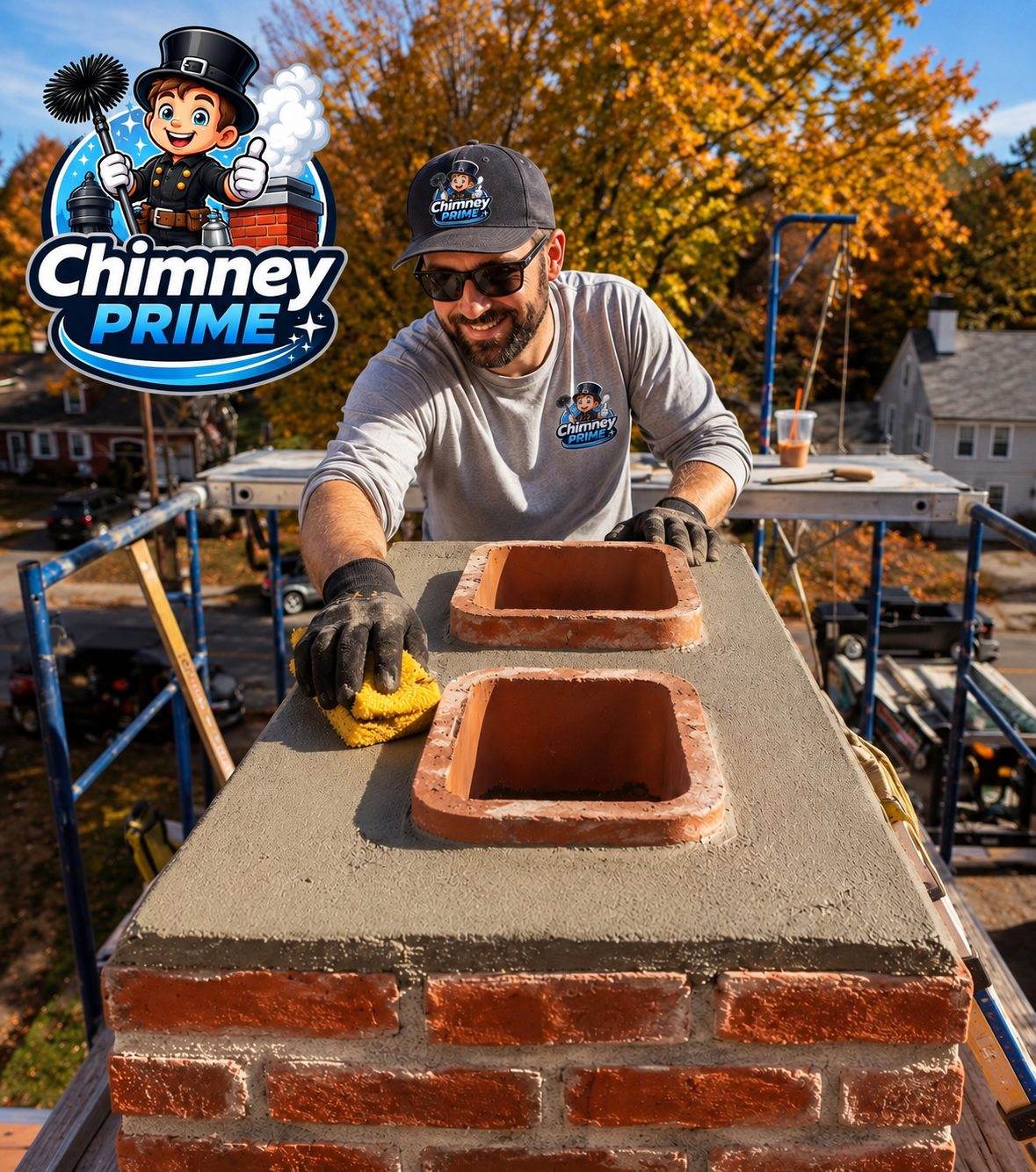
On a masonry chimney, the crown covers the top around the flue openings. If its drainage, material, or joints have failed, work on the wall below may leave an important water route untouched. Chimney crown repair may fit a serviceable crown with limited defects. A chimney crown rebuild addresses a different scope when the existing assembly cannot be restored appropriately.
Ask the evaluator to connect the crown findings to the wall pattern rather than assuming every damaged brick was caused by the top. The flue termination, cap, roof transition, and surrounding roof also deserve consideration. A proposed repair is more persuasive when it explains how water is managed after the work, not just how the finished surface will look.
Mortar repairs must suit the existing masonry
Chimney tuckpointing is commonly used to describe renewing deteriorated mortar joints. The repair should be more than a thin decorative smear. Joint preparation and a compatible replacement material matter, particularly when older bricks are involved. Historic masonry guidance cautions that unsuitable replacement mortar can damage the units it surrounds. NPS: Preservation Brief 2.
For an estimate, ask which joints will be treated and which bricks are considered sound enough to retain. If unit faces are failing, repointing alone may not answer the whole problem. Conversely, an isolated weathered joint does not automatically justify replacing the entire chimney. The written scope should distinguish mortar renewal, individual unit replacement, crown work, and structural reconstruction so you can compare proposals accurately.
Do not confuse surface deterioration with displacement
A leaning stack, displaced courses, large separation, or falling material raises a different concern from superficial weathering. Keep people away from areas below loose masonry and arrange appropriate evaluation. Do not climb onto the roof, push against the chimney, or remove pieces to discover how far the damage extends.
Chimney masonry repair can encompass several kinds of work. When instability or extensive deterioration is involved, a chimney rebuild may be considered, potentially with additional structural expertise. Ask what establishes the boundary between damaged and retainable construction. A recommendation should explain why limited work would or would not address the condition, rather than relying on the vague statement that the chimney is old.
Kansas City exposure is property-specific
A stack beside a tall roof plane may encounter different wetting patterns from one near a ridge. Nearby trees, roof drainage, previous repairs, and the height of exposed masonry can also influence what needs investigation. For a home in Independence, Liberty, or Lee's Summit, regional winter weather is relevant context, but it cannot identify which component failed at that address.
Use seasonal records as a prompt to observe changes, not as proof of damage. The National Weather Service provides Kansas City climate normals, but a long-term average is not a forecast or an inspection finding. NWS Kansas City climate normals. Your own dated photographs, rainfall observations, and repair records are more useful for showing when a specific condition first became noticeable.
Waterproofing is a conditional finishing decision
The term chimney waterproofing can hide important differences between products and applications. Before approving treatment, ask what material is proposed, whether it suits the masonry, and what defects must be corrected first. Coating visibly damaged construction is not equivalent to restoring its condition.
Do not assume every older chimney should be coated, or that a treatment makes the stack maintenance-free. Product guidance and the existing construction should drive the decision, especially on historic masonry. Ask what the treatment is intended to address and what it explicitly does not address. If the estimate describes waterproofing as the solution to leaning, missing bricks, or failed roof flashing, request clarification before proceeding.
Compare repair plans in a useful sequence
First, identify the observed damage and its extent. Second, establish which moisture routes or movement concerns need investigation. Third, define material repairs and any use restrictions. Finally, discuss optional protective measures and monitoring. That sequence helps prevent a sales label from taking the place of a diagnosis.
If two estimates differ, compare their assumptions. One may cover mortar joints only, while another includes brick replacement and a new crown. Ask both providers where their scope stops and what happens if hidden deterioration appears. Do not assume the cheaper proposal is equivalent, but do not assume the larger one is necessary either. Request enough evidence to understand the difference.
What photographs can and cannot establish
A close photograph of a rough brick face can help describe texture, but it does not show how securely the unit is attached or what lies behind it. A wide photograph can show a damage pattern while hiding small joint defects. Request both kinds of documentation when evaluating a proposal. If a contractor needs additional access to resolve the condition, ask which unanswered question that access addresses. This keeps an estimate grounded in what is actually known and makes it easier to distinguish a confirmed repair need from a concern that still requires investigation.
Record what changes after the work
Keep completion photographs showing the repaired areas, along with material information and any maintenance instructions. Note whether the crown or flashing was also addressed. During later ground-level observations, compare the same views and report new flakes, staining, displacement, or water entry.
If new damage appears nearby, that does not automatically prove the repair failed, but it deserves a review of the original scope and the surrounding material. A clear record makes that conversation more productive. It also prevents future confusion between an area that was repaired and an adjacent area that was inspected but left in place.