A fireplace can shape how a buyer imagines a St. Louis home, but appearance says little about the flue above it, masonry outside, or modifications hidden behind finish work. Fresh paint can cover an old ceiling stain. A clean firebox may mean careful maintenance—or long inactivity. “The seller never used it” is a history gap, not a condition report.
A dedicated real estate chimney inspection can document the system while findings still inform the transaction. The objective is not to turn every old component into a demand for replacement. It is to identify what exists, what was observed, what remains inaccessible, and which next steps are reasonable.
On this page
- Schedule the inspection early enough to use it
- Gather the seller’s records
- Identify every fireplace and appliance
- Choose the inspection level for the transaction
- Older masonry requires compatible repair thinking
- Water evidence needs path analysis
- Camera images need interpretation
- General home inspections and chimney inspections differ
- Separate inspection from repair pricing
- Use findings without turning age into a defect
- Avoid test fires in an unfamiliar system
- Build a usable ownership record
- Frequently asked questions
Schedule the inspection early enough to use it
Coordinate access and deadlines as soon as the property and contract allow. Specialized inspection, report review, repair proposals, and seller responses take time. Waiting until the final day can force decisions before questions are answered.
Tell the provider that the visit is for a purchase, how many fireplaces or appliances exist, which fuels are present, and whether a general inspector raised a concern. Do not assume one chimney stack contains only one flue.
Confirm deliverables: inspection level, camera work, roof or exterior access, photographs, written report, limitations, and turnaround. A verbal “looks okay” is difficult to use later.
Gather the seller’s records
Request prior chimney and fireplace inspections, cleaning invoices, masonry and roof repairs, liner documentation, appliance manuals, permits, warranties, gas conversion records, and any chimney-fire or insurance history. Match records to the correct flue and appliance.
An invoice proves that listed work was billed or performed under its stated scope; it does not prove present condition. A proposal is not a completion record. Product warranty language does not establish that installation requirements were met.
If no records exist, do not assume neglect or safety. Treat the history as unknown and establish a baseline.
Identify every fireplace and appliance
Older St. Louis homes can contain site-built masonry fireplaces, later gas logs, wood or gas inserts, decorative sealed openings, basement appliances, or factory-built additions. A brick surround can hide a manufactured metal unit.
Record labels and model information where safely visible. Determine which flue serves each opening. A decommissioned appliance or capped connector still deserves documentation so future work does not encounter an unexplained opening.
Fuel changes matter. A chimney that once served coal, oil, wood, or gas may have been altered or relined. The current appliance does not prove that earlier connections were removed correctly.
Choose the inspection level for the transaction
CSIA’s inspection guidance identifies property transfer and changes to a system among circumstances associated with a Level 2 inspection. A Level 2 camera chimney inspection adds detailed review of internal flue surfaces and appropriate accessible areas. CSIA inspection levels.
The level is not a warranty or pass/fail grade. It defines scope and access. Ask which flues are included, whether deposits limit visibility, and which concealed areas remain unknown.
If serious concerns cannot be resolved through normal access, further investigation may be recommended. Obtain an explanation and approval before destructive access.
Older masonry requires compatible repair thinking
Historic and older St. Louis brick can differ from modern units. Weathered joints may be candidates for chimney tuckpointing when the surrounding wall remains sound. Hard, incompatible prior mortar can damage softer brick even when joints look crisp.
Inspect for spalling, open joints, displacement, leaning, white deposits, dark saturation, crown cracks, missing caps, and repeated patches. Findings should be mapped by elevation and depth. One damaged brick does not require a total rebuild; widespread movement cannot be corrected by surface mortar.
The National Park Service’s repointing brief explains why replacement mortar should be physically compatible with historic masonry. It is useful background, while the actual home and applicable local rules determine the repair. NPS Preservation Brief 2.
Water evidence needs path analysis
Ceiling stains, peeling paint, damp odor, firebox water, rust, efflorescence, and attic staining can involve crown, cap, flashing, roof, masonry, or a framed chase. Water often travels before becoming visible.
Ask when the seller noticed it, what weather triggers it, and whether repairs were tested through later storms. A new interior coat of paint does not demonstrate that a leak was corrected.
Chimney leak repair should connect evidence to a likely route. “Caulk chimney” is not enough scope for a buyer to evaluate.
Camera images need interpretation
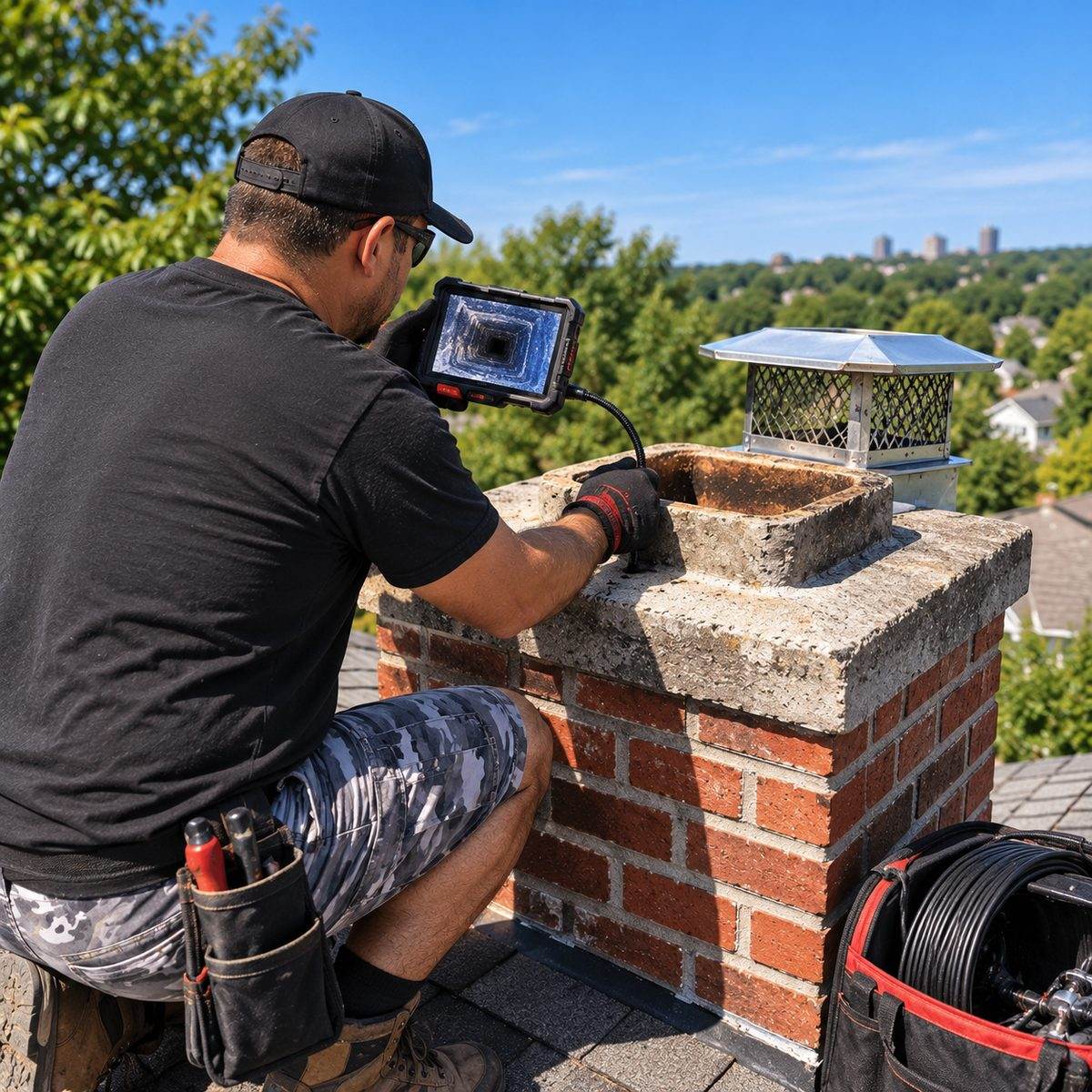
A report should label flue, direction, location, and observed condition. A dark line can be a crack, joint, deposit edge, shadow, or construction feature. The evaluator should explain what supports the interpretation and whether cleaning or another view is needed.
Clay-tile cracks, open joints, displaced sections, restrictions, and liner changes may affect use or repair planning. A metal liner should be identified by available records and visible components; a shiny surface alone does not supply alloy, insulation, or fuel rating.
Request original images or a clear report, not only a low-resolution screenshot attached to an estimate.
General home inspections and chimney inspections differ
A home inspector provides broad property evaluation under their scope. They may identify visible leaning, staining, damaged firebrick, or recommend specialized review. They may not camera-scan flues, identify every listed component, access the roof, or design a repair.
Use the services together. Share the general report with the chimney professional and return relevant specialized findings to the broader transaction team. Do not interpret a referral as proof that a major defect exists; it means the question exceeds that inspection scope.
Separate inspection from repair pricing
The inspection establishes conditions and limitations. An estimate prices a proposed response. Ask the report to distinguish use-related concerns, active water entry, durability work, optional improvements, and monitoring. This helps prevent every item from appearing equally urgent.
Obtain comparable scopes for significant work. One “repair chimney” bid may mean crown coating, while another includes ten courses of rebuilding and flashing. Compare quantities, materials, access, exclusions, and documentation.
The cheapest price is not meaningful if it addresses a different condition. The highest estimate is not automatically the most complete.
Use findings without turning age into a defect
An older fireplace is not defective merely because it is old, and a system that has lasted for decades is not proven safe merely because previous owners used it. Ask the evaluator to base conclusions on observable condition, identified components, applicable instructions, and stated inspection limitations. Dates are useful context for repairability and product support, not a substitute for evidence.
Translate findings into technical priorities before discussing the transaction. Separate conditions that restrict use, active water entry, deterioration that should be repaired, items that can be monitored, and elective improvements. If a report recommends further evaluation, identify the unanswered question and the access or test needed to answer it.
Real-estate agents, attorneys, insurers, and lenders should handle contract, disclosure, coverage, and negotiation questions within their roles. The chimney professional can clarify scope, urgency, dependencies, and likely access. When a credit or repair request is considered, tie it to a documented scope rather than a round number based on the chimney’s age. This keeps the technical record useful regardless of who ultimately pays for the work.
Avoid test fires in an unfamiliar system
Do not ask the seller or inspector to light a wood fire merely to prove operation when condition is unknown. Draft during one short fire does not establish liner integrity, and a defect can create risk.
For gas appliances, normal functional checks should follow the inspection scope and model instructions. If gas odor is present, leave and contact emergency services and the utility from a safe location.
After closing, do not use the fireplace until stated repairs, cleaning, curing, and follow-up evaluation are complete.
Build a usable ownership record
Keep the transaction report, photos, estimates, completed invoices, permits, manuals, liner product details, and final documentation in one folder. Note which recommendations were completed and which remain.
This baseline will make annual inspection and future appliance decisions more efficient. It also prevents the next buyer from receiving only a vague statement that “someone looked at it.”