
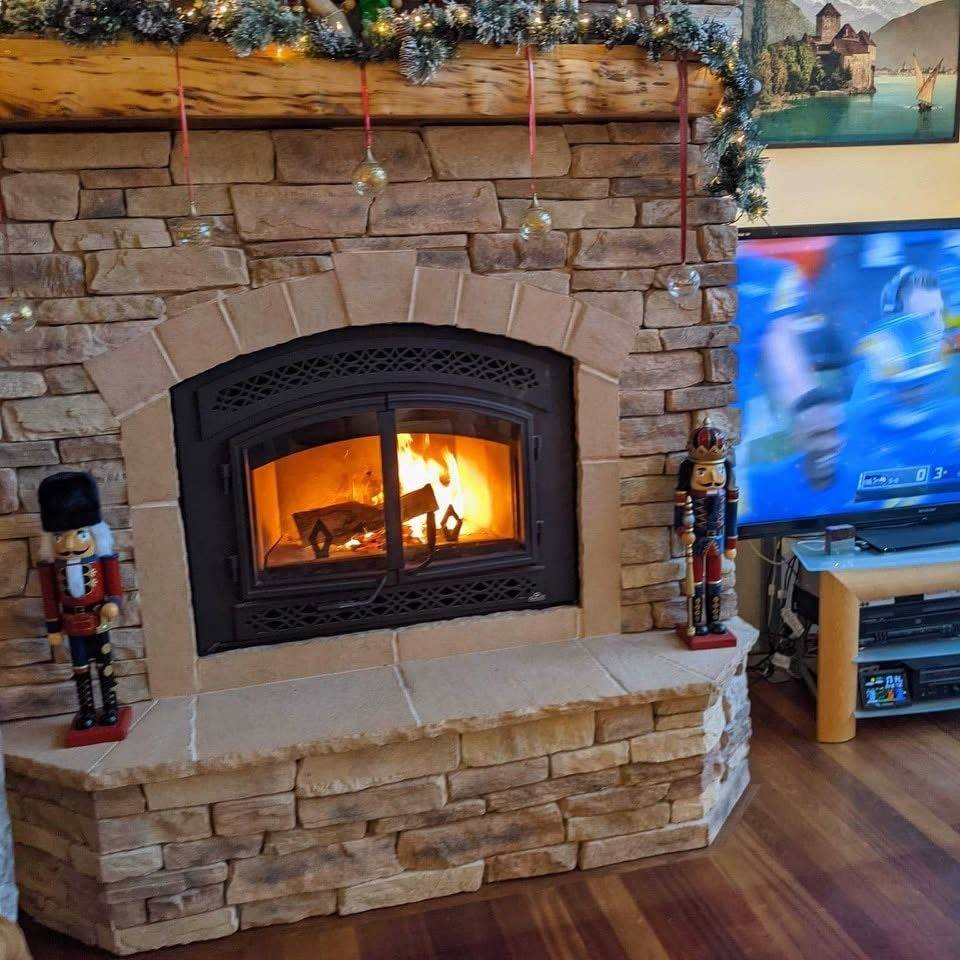
Fireplace doors can update appearance, reduce some idle air movement, and help contain sparks when used as designed. They do not convert every open fireplace into a sealed heater, and they are not universal accessories. The opening, fireplace construction, mounting surface, hearth, lintel, airflow, glass material, and operating instructions determine what fits.
Professional fireplace door installation starts by identifying masonry or factory-built construction. A door intended to overlap a masonry opening can be unsafe on a manufactured metal fireplace that requires model-specific cooling airflow.
On this page
- Identify the fireplace before measuring
- Measure width and height in several places
- Glass type is part of the operating design
- Open or closed during a fire depends on the product
- Airflow around factory-built fireplaces must remain open
- Mounting must be secure without damaging the fireplace
- Doors can reduce drafts but do not seal every path
- Gas logs and doors need compatibility
- Screens still perform an important function
- Stock, custom, and arched doors require different planning
- Maintenance preserves operation
- Frequently asked questions
Identify the fireplace before measuring
A masonry fireplace typically has individual firebrick, a masonry opening, and a site-built chimney. A factory-built fireplace often has a metal firebox, label, louvers or air spaces, and molded refractory panels. Decorative stone or brick facing can hide the distinction.
For a factory-built unit, locate the exact manufacturer and model. Use only doors or fronts permitted by its manual. Generic clamps, magnets, drilling, or masonry frames can interfere with the tested assembly, damage metal, or block air.
If identification is uncertain, arrange a fireplace inspection before product selection.
Measure width and height in several places
Masonry openings are rarely perfectly square. Measure width at top, middle, and bottom and height at left, center, and right. Note the smallest dimensions, lintel position, raised hearth, projecting stone, uneven mortar, and any surround that prevents a frame from sitting flat.
The product may be an overlap fit covering the face or an inside fit within the opening. Each uses different tolerances and mounting. Record the flat mounting area available around all sides and whether the hearth projects in front of the frame.
Use the manufacturer’s measuring form. A custom template may be needed for arches, corners, or irregular stone. Do not order from a single nominal fireplace size.
Glass type is part of the operating design
Tempered glass is commonly used in doors that must remain open during a hot wood fire and close only when the fire has died according to instructions. Ceramic glass tolerates higher temperatures and appears in products designed for different operating conditions. The door and fireplace manuals—not the word “heat resistant”—determine permitted position.
Ordinary window glass, shower glass, acrylic, and improvised panes are not fireplace replacements. Correct thickness, edge treatment, retainers, expansion allowance, and gasket or clip design matter.
If a pane breaks, replace it with the specified material and method. Do not operate with a missing pane or tape a crack.
Open or closed during a fire depends on the product
Many masonry fireplace door sets instruct users to keep glass doors fully open while wood burns, with a mesh screen closed for sparks. Partly open doors can expose edges to concentrated heat and distort airflow. Other tested assemblies permit a different operating position.
Read and preserve the actual instructions. Teach every household member. A door should not be closed to control an oversized fire or compensate for a smoking fireplace.
Keep the chimney damper fully open during combustion as required. Doors do not replace the vent path or make carbon monoxide harmless.
Airflow around factory-built fireplaces must remain open
Louvers or gaps around a manufactured fireplace can circulate cooling or convection air. Covering them with a masonry-style frame, sealant, or finish material can overheat the unit. Drilling the metal face may also violate its instructions.
Approved factory doors are designed with the model’s airflow and attachment points. Majestic’s manuals portal illustrates why the exact model is needed for accessories and service parts. Majestic user guides and manuals.
If original doors are unavailable, do not assume a similar-size replacement is compatible. Ask for documented approval or consider leaving the listed screen arrangement intact.
Mounting must be secure without damaging the fireplace
Masonry door frames may use lintel clamps, brackets, anchors, or other specified hardware. The mounting surface must be sound. Loose brick, deteriorated mortar, or cracked stone should be repaired appropriately before attachment.
Do not drive fasteners into a clay liner, metal firebox, or unknown concealed area. Adhesive alone may not withstand heat or frame movement. Hardware should allow the glass and metal to expand as designed.
After installation, doors should swing freely, latches align, panels remain secure, and handles clear the hearth and screen. The frame should not block damper controls or gas shutoff access.
Doors can reduce drafts but do not seal every path
Closing doors on a cold, unused masonry fireplace may reduce room air entering the opening. However, air can still move through the damper, ash dump, outside-air opening, panel gaps, or chimney. Most decorative doors are not airtight.
If cold air or summer odor is the main concern, evaluate damper condition, house pressure, moisture, deposits, and other leakage paths. A top-sealing damper may be considered in a compatible wood-burning masonry system, but not where gas equipment requires a permanently open flue.
Do not caulk operational air gaps around a factory-built fireplace to chase energy savings.
Gas logs and doors need compatibility
Vented gas-log sets can require doors open during operation, specific clearances, a hood, or other conditions. Vent-free products have different rules and may be prohibited with certain enclosures. A sealed gas fireplace already has its own glass system and should not receive decorative doors over required openings unless approved.
Identify the log-set and host-fireplace manuals before adding doors. Flame impingement, overheating, and control access matter. Never close doors to hide abnormal soot or delayed ignition.
If gas odor is present, leave and contact emergency services and the gas utility from a safe location.
Screens still perform an important function
Open glass doors do not contain sparks. Use the approved mesh screen during wood fires. It should close across the opening without contacting flames or logs and remain stable when doors are open.
Screens and glass become hot. Maintain a child and pet safety zone. Protective barriers do not make the surrounding metal, handles, hearth, or glass cool.
Replace torn mesh or broken retainers with suitable parts. Do not hang holiday decorations from a hot frame.
Stock, custom, and arched doors require different planning
Stock door sets fit only the opening ranges and mounting conditions specified by their manufacturer. A masonry opening that appears rectangular may taper, lean, or vary from front to back, so record width and height at several points and note the lintel, hearth slope, projection, and surrounding trim. Measure using the door maker’s method rather than subtracting an arbitrary allowance.
Custom doors can address unusual proportions, an arched opening, or a specific overlap, but “custom” does not waive temperature, ventilation, mounting, or operating requirements. Arched work may need a rigid template and clearly marked reference line. Approve the frame dimensions, glass type, finish, handles, screen, hinge direction, and mounting method in writing before fabrication; made-to-order components may not be returnable.
For a factory-built fireplace, begin with the data label and manual. Use only a door or kit approved for that identified model. Drilling the face, blocking cooling louvers, or adding the weight of an unrelated enclosure can interfere with the listed assembly even if the door fits visually. If the model cannot be identified, document that limitation before ordering.
Ask about replacement panes, screens, handles, and clips. A fashionable finish is less useful if ordinary service parts will be unavailable. Do not add household caulk, improvised gasket, or magnets to make decorative doors airtight. If smoke enters the room or cold air persists, diagnose draft, damper, pressure, venting, or moisture rather than forcing the door assembly to perform a function it was not designed to provide.
Maintenance preserves operation
Allow the assembly to cool fully. Clean glass with the product and method specified by the door manufacturer; abrasive pads or inappropriate chemicals can scratch coatings or damage finish. Keep tracks, hinges, and latches free of ash without applying unapproved lubricant near heat.
Inspect clips, gaskets where used, handles, and mounting hardware. Report loosening, distortion, discoloration, or recurring breakage. A frame that shifts can indicate poor mounting or movement in the surrounding masonry.
Doors do not eliminate chimney inspection and cleaning. Maintain the fireplace and venting system according to use and condition.